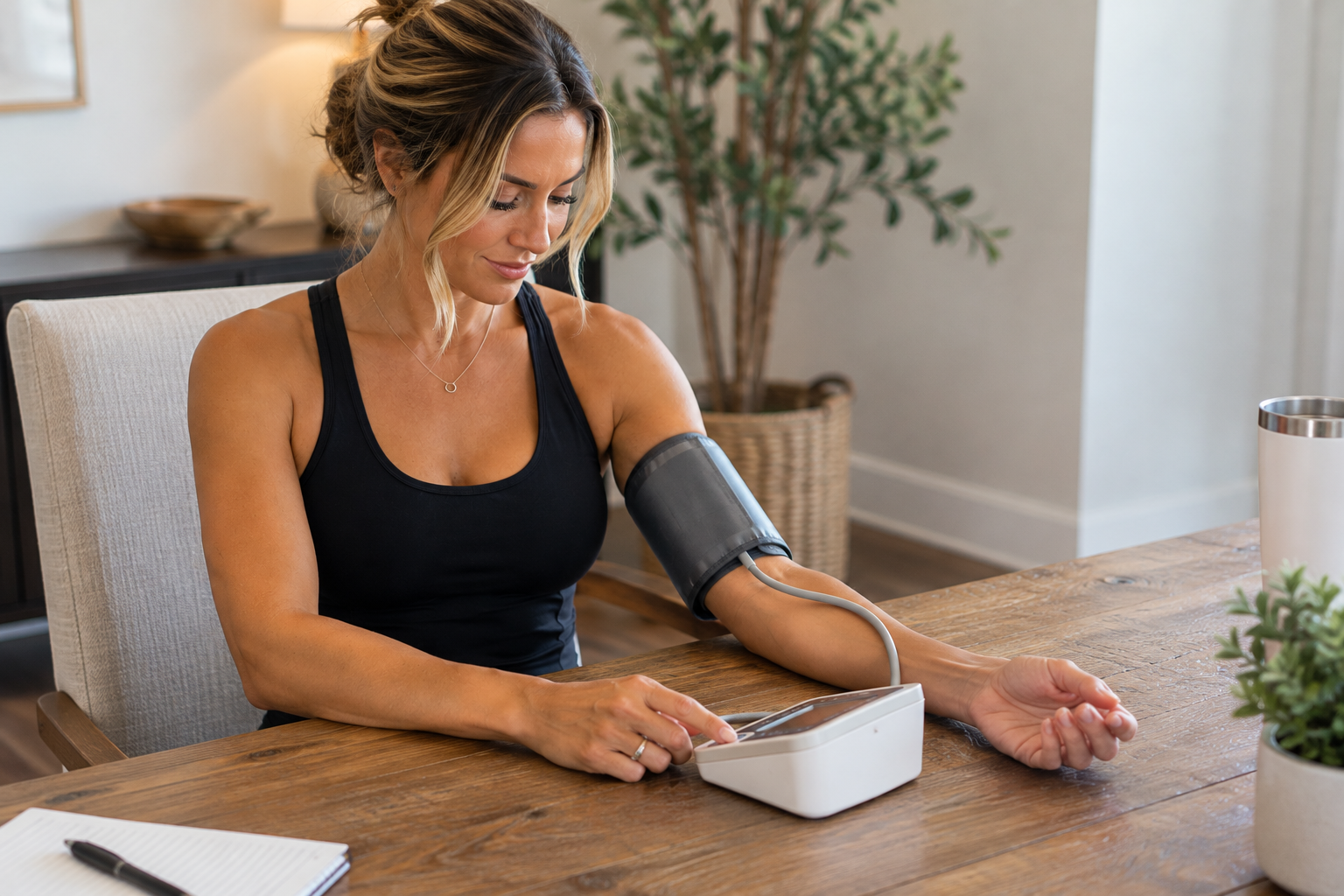
Postural Hypotension Test (Ragland's Test)
How to Perform the Ragland’s Postural Blood Pressure Test at Home
A simple, noninvasive assessment of how your body responds to changes in position
At Dr. Robyn Functional Medicine, we use a variety of assessments to better understand how your body is functioning. One of the tests we routinely perform during our initial functional medicine consultations is the Ragland’s Postural Blood Pressure Test, also known as the Postural Hypotension Test.
This assessment measures how your blood pressure changes as you move from sitting to lying down and then immediately to standing.
We use this information as part of our evaluation of your autonomic nervous system, cardiovascular regulation, circulation, and overall physiological stress response.
For our virtual patients, or those who need to repeat the assessment between appointments, this test can be performed at home using an automatic upper-arm blood pressure monitor.
What Is the Ragland’s Test?
Your body constantly adjusts your blood pressure to maintain adequate circulation as you move throughout the day.
When you lie down, gravity has less influence on blood distribution, and your cardiovascular system adjusts accordingly.
When you stand, gravity temporarily shifts blood toward your lower extremities. Your autonomic nervous system responds by adjusting blood vessel constriction and heart rate to help maintain blood flow to your brain.
The Ragland’s Test evaluates how your systolic blood pressure (the top number) changes during these transitions.
Historically, this test has also been used in nutritional and functional medicine assessments to explore patterns associated with physiological stress and adrenal health. However, it does not directly measure adrenal hormone production or diagnose adrenal dysfunction.
Why Do We Perform This Test?
Your blood pressure response can provide helpful clues about how effectively your body adapts to positional changes.
We evaluate these findings alongside your health history, symptoms, nutrition, hydration, sleep, stress, and laboratory results when appropriate.
An unusual response may lead us to investigate factors such as:
Autonomic nervous system regulation
Hydration and electrolyte balance
Circulatory function and blood pressure regulation
Medication effects
Nutritional status and overall physiological stress
Hormonal or endocrine conditions when clinically indicated
How to Perform the Test at Home
What You'll Need:
An automatic upper-arm blood pressure monitor
A chair
A bed or comfortable surface where you can lie flat
A place to record your results
Someone to assist you if you are prone to dizziness or lightheadedness
For consistency, we recommend performing the test in the morning, before caffeine or exercise, and under similar conditions each time you repeat it.
Step 1: Sitting Blood Pressure — Baseline
Sit comfortably in a chair with your back supported and both feet flat on the floor.
Rest quietly for approximately 3-5 minutes.
Place your blood pressure cuff on your upper arm, following the manufacturer's instructions.
Keep your arm supported at heart level.
Take your blood pressure reading.
Record your systolic pressure (top number), diastolic pressure (bottom number), and heart rate.
This is your sitting baseline.
Step 2: Lying Down — Supine Blood Pressure
Lie flat on your back on a bed or comfortable surface.
Remain relaxed and still for approximately 2 minutes.
Keep your cuff on your arm, positioned at approximately heart level.
Take another blood pressure reading while remaining completely flat.
Record your blood pressure and heart rate.
In the traditional Ragland’s assessment, we compare this reading with your sitting baseline to evaluate how your blood pressure responds to a more relaxed, horizontal position.
Step 3: Standing Blood Pressure — Immediate Response
This is the most important part of the test.
Keep the blood pressure cuff securely positioned on your arm while lying down.
Make sure the monitor is ready to begin measuring.
Stand up carefully but promptly.
As soon as you are fully standing, immediately press START on your automatic blood pressure monitor.
Remain standing still while the monitor completes the reading.
Keep your cuffed arm supported near heart level without moving unnecessarily.
Record your systolic pressure, diastolic pressure, and heart rate.
If you become dizzy, faint, or unsteady, stop the test and sit or lie down.
Record Your Results
1. Sitting Blood Pressure (Baseline)
Blood Pressure: ______ / ______ mmHg Heart Rate: ______ BPM
2. Lying Down (After 2 Minutes)
Blood Pressure: ______ / ______ mmHg Heart Rate: ______ BPM
3. Immediately Upon Standing
Blood Pressure: ______ / ______ mmHg Heart Rate: ______ BPM
Additional observations:
Did you experience dizziness, lightheadedness, weakness, blurred vision, palpitations, or any other symptoms during the test? Please record these as well.
Understanding Your Results
Sitting to Lying Down
In the traditional Ragland’s testing protocol, a decrease of approximately 6–10 mmHg in systolic blood pressure from sitting to lying down is described as an expected response.
We observe this transition to understand how your blood pressure changes when gravitational demands are reduced.
An unusual response may indicate dehydration or warrant further kidney evaluation. Kidney health is assessed through appropriate medical history and laboratory testing.
Lying Down to Standing: Understanding Your Stress Response
In the traditional Ragland’s Test, we look for an increase in systolic blood pressure (the top number) of approximately 6–10 mmHg upon standing. This is considered a favorable response, indicating that your body is adapting to the change in position.
When systolic blood pressure decreases instead of increasing, I consider this a potential sign that your body's stress-response systems may need additional support.
In functional medicine training, these responses are associated with different phases of the stress-response model:
Normal Response: Systolic blood pressure increases approximately 6–10 mmHg upon standing.
Phase 2 – Resistance: Systolic blood pressure decreases rather than increases, suggesting a possible challenge with physiological stress adaptation.
Phase 3 – Exhaustion: Systolic blood pressure drops by 20 mmHg or more, representing a more significant change that warrants further evaluation.
A sustained decrease of 20 mmHg or more in systolic pressure, or 10 mmHg or more in diastolic pressure, within 3 minutes of standing meets the standard criteria for orthostatic hypotension. This can have several underlying causes, including dehydration, medication effects, autonomic dysfunction, and certain endocrine conditions.
How We Use Your Results in Functional Medicine
At Dr. Robyn Functional Medicine, we don't evaluate a single test result in isolation.
Your postural blood pressure response is one piece of a larger picture that includes your symptoms, nutritional status, lifestyle, stress exposure, sleep quality, and laboratory findings.
Our goal is to identify factors that may be affecting your body's ability to regulate and adapt, then develop an individualized plan to support your overall health.
When Should You Repeat the Test?
We may recommend repeating this test during your care to monitor changes over time.
For the most consistent results, use the same blood pressure monitor, follow the same steps, and perform the test at approximately the same time of day.
Please record all three blood pressure readings and send your results to our office before your next functional medicine appointment.
Not a patient yet? Click below to schedule your initial Functional Medicine Consultation and get started on your wellness journey!